BP could attempt 'Static Kill' on Tuesday
BY Aliyah ShahidDAILY NEWS STAFF WRITER – August 3rd 2010

Thick oil from the BP Deepwater Horizon spill floats on the surface of the water in Bay Jimmy, Louisiana.
Tuesday might just be the day that the disastrous Gulf oil leak is finally and completely stopped.
Crews hope to begin forcing mud and maybe cement down the throat of the blown out oil-well, which has dumped 4.9 million barrels into the Gulf of Mexico, sparking the largest accidental oil spill of all time.
The plan, dubbed "static kill," will replace an experimental cap — the only thing keeping oil from spewing back into the ocean for the past two weeks. Engineers will conduct tests to determine if the broken blowout preventer can handle the static kill. If the tests go well, they plan to spend Tuesday through Thursday pumping mud into the well.
On Monday, the test was delayed due to a hydraulic leak. Previously, BP officials argued that two relief wells — which come with a hefty price tag of $200 million — were the only guarantee to stop the leak. But this week, they said the static kill alone may be enough.
Kent Wells, BP's senior vice president, said one of the primary relief wells that is nearly completed could be used to guarantee that the leak is fixed from the bottom instead of the top. "Even if we were to pump the cement from the top, we will still continue on with the relief well and confirm that the well is dead," Wells said, adding that regardless, "we want to end up with the cement in the bottom of the hole." The Deepwater Horizon exploded April 20 off the coast of Louisiana, killing 11 workers and polluting the areas water, beaches and marshes.
New study aims to locate underwater oil from Gulf spill
With oil from the BP spill fast disappearing from the surface of the Gulf of Mexico, a marine conservation group is embarking on a two-month expedition to evaluate the impact of oil remaining below the surface.
The study by the conservation group Oceana set to begin August 7 is among several aiming to learn the potential long-term effects of the disaster from the ruptured BP well that released millions of gallons of crude oil into the Gulf waters.
The study by the conservation group Oceana set to begin August 7 is among several aiming to learn the potential long-term effects of the disaster from the ruptured BP well that released millions of gallons of crude oil into the Gulf waters.

Underwater Oil
Michael Hirshfield, chief scientist at Oceana, said the mission hopes to get a better understanding of the unique situation in which oil mixed with chemical dispersants remained below the surface.
"It is clear that a lot of oil never reached the surface and has remained underwater," Hirshfield said.
"We are concerned about the impacts of that oil on creatures that may not be visible from shore, including plankton, fish eggs and larvae, adult fish, sharks, marine mammals and corals."
Hirshfield said the study will provide a baseline for long-term analysis and may help provide information on how best to deal with any future oil leaks. "No one knows for sure how long the oil will be toxic under water," he said.
"That is one of the things we hope to document. The good news is that fish testing has shown that fish from the Gulf caught in the open areas is safe. So the fish will be safe. "However, there may not be so much as before if the oil killed the eggs and larvae and young fish." For this study, Oceana will charter the Latitude, a 51-meter (168-foot) expedition ship capable of sailing in both shallow and deep waters. It sails from Fort Lauderdale and will work for two months in the Gulf of Mexico.
The team of scientists will tag marine animals including sharks and turtles and take samples of sediments, larvae, plankton and water. Dredges and nets will be used in collaboration with various universities. A separate study launched July 10 by the National Oceanographic and Atmospheric Administration is expected to have results soon.
Joe Lepo, a scientist at the Center for Environmental Diagnostics and Bioremediation at the University of West Florida who is working with NOAA, said it is clear that much of the oil, which would normally float to the surface, had remained underwater. "This is a relatively light, 'sweet' crude that probably lost 50 percent of its mass upon exposure to air, by evaporation of its lighter fraction. And certainly a lot of the oil sunk," he said.
"The problem with this spill is its confined area, so there is a high concentration of hydrocarbons. The good news is that most of the oil that sinks becomes relatively non-bioavailable and biodegrades very slowly over many years. This is a natural process and I am optimistic that open water wildlife will be minimally affected." But the scientist said the long-term impacts are still likely to be significant from the spill with an estimated three to 5.2 million barrels (117.6 million to 189 million gallons) having gushed out into the Gulf. "The biggest long-term contamination problem will be in coastal marshlands," he said, noting that oil may get trapped in marsh sediments and continue to impact wildlife.
Testing to precede 'static kill' maneuver in Gulf
New Orleans, Louisiana (CNN) -- One of two efforts to seal the ruptured BP oil well in the Gulf of Mexico once and for all is set to take place Tuesday, after a crucial test is conducted Monday to determine whether it will work, BP's senior vice president told reporters.
In the "injectivity" test, "base oil" will be pumped into the ruptured well bore to determine if it will go back into the reservoir, Kent Wells said Monday. The test will start with pumping one barrel per minute, then two, then three. How much is pumped will depend on how the test goes, Wells said.
"We would expect to have the test done in a few hours," he said, and then the data will be analyzed. The information will tell officials whether adjustments need to be made on "how and if" the "static kill" procedure will take place Tuesday, he said.
The static kill would involve pouring mud, possibly followed by cement, into the well from above -- a process that had been delayed while debris from a tropical storm was cleared out.
The goal is to push all the oil back into the reservoir.

BP COO Doug Suttles
I do have a lot of confidence we'll be successful," Doug Suttles, the oil giant's chief operating officer, said Sunday.
The static kill procedure would begin Tuesday and could run into Wednesday, Wells said. BP may follow the mud with cement, depending on where the flow in the well is located.
The cementing is a "very important decision" that will be made after the mud has been pumped in and further analysis completed, Wells said.
The procedure would be followed by a final "bottom kill" after a relief well intercepts the crippled well -- a step it is estimated will start about five to seven days after the static kill is complete.
If the injectivity test is not successful, then the static kill procedure would be skipped and the bottom kill effort would proceed, Wells said Monday. The government point man on the Gulf oil spill last week warned against elevated optimism. "We should not be writing any obituary for this event," said Thad Allen, a retired Coast Guard admiral.
Officials said Monday a rig drilling one of two relief wells had completed running and laying casing pipe to reinforce it. Pressure in the capped well was at 6,989 pounds per square inch, and no anomalies had been detected. As the oil giant prepares to launch the latest effort, Homeland Security Secretary Janet Napolitano is expected to travel to New Orleans on Monday. She will review the oil spill response with federal, state and local officials.
Napolitano's trip comes a day after Allen rejected accusations by a congressional subcommittee that federal officials allowed BP to use excessive amounts of chemical dispersants. BP used the chemicals to break up oil after the April 20 Deepwater Horizon rig explosion sent millions of gallons of crude gushing into the Gulf.
Despite a federal directive restricting their use, BP "carpet bombed the ocean with these chemicals, and the Coast Guard allowed them to do it," said Rep. Edward J. Markey, chairman of the House Energy and Environment Subcommittee. Markey said the Coast Guard ignored a directive to allow dispersants only on rare occasions.
It approved more than 74 exemptions in 48 days, Markey said. In one instance, Coast Guard officials allowed the oil giant to use a larger volume of dispersants than it had applied for, he said.
Dispersants are "a toxic stew of chemicals, oil and gas, with impacts that are not well understood," Markey, a Democrat from Massachusetts, said in a letter to Allen.
"The EPA actually said that dispersants, these chemicals, should be used when spraying the surface of the ocean only in rare instances," Markey said on CNN's "American Morning" on Monday. "What it turns out happened is that BP, for all intents and purposes, sprayed just about every single day, and on some days they did so in quantities that were far in excess" of what was reported to the Coast Guard, he said. Underwater effects caused by the chemicals will need to be carefully monitored, Markey said.
Allen on Sunday defended the use of dispersants as a "very disciplined" procedure. Field commanders used dispersants when oil was spotted by surveillance aircraft and no other method of cleaning it up was available in the area, he said. BP also dismissed Markey's allegations and said it has worked closely with the Environmental Protection Agency and the Coast Guard from the start. The oil company is funding research into the long-term effects of the spill, including the use of dispersants, Suttles said. CNN's Vivian Kuo contributed to this report.
BP hopes 'static kill'
will plug leaking well permanently
A new attempt by BP to "kill" its broken oil well was gearing up Monday.
The new procedure, dubbed a "static kill," involves injecting drilling mud into the broken well in a bid to plug it and then cover it with cement.
Preliminary tests to determine whether oil and gas trapped in the now-capped well can be removed were to begin Monday afternoon, according to BP VP Kent Wells.
A similar attempt in May failed, though scientists are unsure why. Whether or not the static kill works, BP will keep drilling the relief well that it began in May. The relief well should intercept the broken well sometime between Aug. 11 and 13 and finally end the threat of spilling oil for good.
The new operation comes 18 days after BP finally managed to stop the oil gusher with a tight-fitting cap that siphons the oil to waiting surface ships. The well had been gushing out of control, polluting fragile fishing grounds, beaches and marshes, since the April 20 explosion on the Deepwater Horizon drilling rig, which killed 11 workers.
A new Atlantic weather system that could strengthen into Tropical Storm Colin by the weekend is not expected to threaten the Gulf or the massive containment and cleanup operation.
Toxic chemical used on Gulf oil spill
Associated Press–Sunday, 1 August 2010
The US Coast Guard has routinely approved BP requests to use thousands of gallons of toxic chemical a day to break up oil slicks in the Gulf of Mexico despite a federal directive that the chemicals be used only rarely on surface waters, congressional investigators said after examining BP and government documents.
The documents show the Coast Guard approved 74 waivers over a 48-day period after the restrictions were imposed, resulting in hundreds of thousands of gallons of the chemicals to be spread on Gulf waters. Only in a small number of cases did the government scale back BP's request.
The extensive use of dispersants to break up oil gushing from BP's Deepwater Horizon raised concerns early on as to what long-term damage the toxic chemicals might be doing to the Gulf's aquatic life. That prompted the Environmental Protection Agency on May 26 to direct BP to stop using the chemicals on the water surface except in "rare cases".

Republican Ed Markey
But Republican Edward Markey said that the chemicals continued to be used extensively with Coast Guard approval, often at a rate of 6,000 to 10,000 gallons a day. A request was made and approved on June 13 to spread as much as 36,000 gallons of dispersant, according to data obtained by Markey's Energy and Environment subcommittee.
The EPA directive "has become more of a meaningless paperwork exercise than an attempt ... to eliminate surface application of chemical dispersants," Markey wrote in a letter sent on Friday to retired Coast Guard Adm. Thad Allen, the government's point man on the spill.
Markey's office released the letter yesterday as well as the documents his panel had analysed. Markey said that instead of complying with the EPA directive, "BP often carpet bombed the ocean with these chemicals and the Coast Guard allowed them to do it".
The House investigators found that the Coast Guard routinely approved the chemical use, in some cases a week in advance. On five occasions the Coast Guard approved a BP request to use 6,000 gallons a day over a week-long period and "in many of these days BP still used more than double" the limit that was approved, Markey said in his letter.
The chemicals break down masses of oil into small droplets that allow the oil to be more easily consumed by bacteria. But the chemicals are also toxic and it's not known what impact the large volume of chemicals being used against the BP spill might be having on marine life.
The EPA has acknowledged that there are trade offs and that some use of the chemicals are essential to combat the oil spill. The EPA directive issued in May concerned only surface dispersal of the chemicals. BP also has been using large amounts of chemicals near the ocean floor at the site of the damaged wellhead.
In recent weeks, little oil has been noticed on the Gulf surface, and scientists believe one reason for that might be the extensive use of the chemical dispersants.
BP to Begin Permanent Plugging of U.S. Gulf Well
Aug. 1 (Bloomberg) -- BP Plc plans this week to inject mud down its Macondo well in the Gulf of Mexico to begin permanently plugging the source of the largest oil spill in U.S. history.

BP's Kent Wells
The injection process, a so-called static kill, will start tomorrow or on Aug. 3, Kent Wells, London-based BP’s senior vice president for exploration and production, told reporters on July 30. Once drilling mud overpowers pressure coming up from oil and gas in the reservoir, the company may use cement to plug the well from the top.
Static kill will make it safer for BP to permanently plug Macondo from below through a nearby relief well later this month. The company has started installing casing in the relief well to protect the borehole from being damaged during the static kill and to prepare for injecting mud and cement for the final plugging, according to a statement today on BP’s website.
“I give a reasonable chance of success to this operation,” Arthur Berman, who owns Houston-based Labyrinth Consulting Services Inc., which specializes in subsurface petroleum geology, said by telephone yesterday. “Nothing is 100 percent, but I think we’re all hoping that the relief well is the final solution.”
Successful plugging would ensure that no more oil leaks from a well that killed 11 workers in an April 20 drilling-rig explosion and led to a record loss at BP. The flow of crude from Macondo has been stopped since BP sealed it on July 15 through a valve stack placed atop the well.
Flow Estimate
National Incident Commander Thad Allen said July 30 that the government will release a new estimate within a few days for the amount of oil that was leaking into the Gulf.
The estimated range will probably widen from a June 15 measure of 35,000 to 60,000 barrels of oil a day, researcher Ira Leifer, a member of the panel of scientists advising the U.S. Energy Department on the spill’s size, said in a July 30 interview.
“There’s just a lot of uncertainty because there was no monitoring system put in place,” said Leifer, a University of California, Santa Barbara researcher.
Static Kill
Near the well site, 40 miles (64 kilometers) off the Louisiana coast, BP said it will have 12,000 barrels of 13.2-pound-per-gallon mud ready for the static kill, six times more than the company estimates will be needed.
BP will pump the mud, which is heavier than oil, into the damaged well, pushing the oil back into reservoir until the well pressure is zero.
The Obama administration imposed a six-month moratorium on new deepwater drilling permits in the wake of the spill.
Legislative Reaction
The U.S. Senate may act on oil-spill legislation this week after the U.S. House pushed through its version of offshore safety and environmental rules on July 30. The House bill would eliminate a $75 million cap on liability for companies responsible for spills, and bar BP from new offshore leases.
BP informed the governments of Vietnam and Pakistan that it put its production assets in the countries up for sale as a part of company’s plan to dispose of $30 billion of assets to raise cash to cover costs associated with the Gulf of Mexico disaster.
To contact the reporter on this story:Katarzyna Klimasinska in Houston
To contact the editor responsible for this story:Tony Cox
Concerns for local fishermen as Gulf focus shifts
by Staff WritersNew Orleans, Louisiana (AFP)
July 29, 2010
US officials sought Thursday to reassure fishermen they will not lose out in the next phase of the Gulf of Mexico oil clean-up, while legal wranglings began for the BP trial of the decade.
As final preparations were put in place for operations next week to permanently kill the well, US spill chief Thad Allen convened a meeting of parish presidents in New Orleans to discuss how best to safeguard local jobs going forward.
With less oil floating in the Gulf, there are fears BP might scrap its "Vessels of Opportunity" program which employs more than 1,500 boats, providing desperate fishermen with vital skimming and boom-laying work
"If BP uses the capping of the well as an excuse to minimize its clean-up operations, then shame on them," said Captain Mike Frenette, whose five boats in Venice, Louisiana missed an entire summer's fishing due to the disaster.
Frenette had to apply four times before getting two of his five boats onto the program, which pays between 600 and 3,500 dollars a day, depending on the size of the boat.
"The paperwork kept getting lost," he said. "And all that our Vessels of Opportunity work is doing is counting against our compensation claim. We're not making any money, here, we're just trying to keep our heads above water."
A large portion of the Gulf waters remain closed to commercial and recreational fishing and with lingering doubts about seafood safety, fishermen could effectively end up losing their jobs for a second time.
"The fishermen have missed a year, and we don't know what the impact is going to be next year, or the year after that," said Marty O'Connell, an environmental scientist at the University of New Orleans.
Clean-up crews are collecting samples of fish and shrimp at depths of between 30 and 360 feet to test them for contaminants, but it will take years to fully know the impact of the oil disaster on Gulf fisheries.
Allen pledged earlier this week to keep as many "Vessels of Opportunity" as possible, hoping they could be redeployed to test for any underwater plumes.
A massive task also lies ahead in picking up some 20 million feet (3,800 miles) of protective boom laid to protect Gulf shores from the once-giant slick that has now diminished to just a few patches of light sheen.
Ahead of the meeting with Allen, Saint Tammany parish president Kevin Davis, said he was against reducing any oil-fighting resources for the time-being.
"Although the well is capped, we cannot let down our guard until we are absolutely certain that no oil lingers under our waters," he said.
Meanwhile, BP lawyers were set to come face-to-face Thursday with victims of the spill during a first court hearing into the case, which is likely to become the trial of the decade.
The hearings in Boise, Idaho, will examine whether complaints submitted by some 200 plaintiffs can be consolidated.
A decision is expected around two weeks after the hearing, but the session will give trial lawyers a test run for the arguments they will make during what could be years-long legal proceedings.
Law professor Richard Nagareda said the seven federal judges of the Multidistrict Litigation Panel (MDL Panel) could in theory choose to send one consolidated case to any US federal court.
The hearing will bring together a wide array of people and players linked to the disaster triggered by an April 20 explosion aboard the Deepwater Horizon rig, which killed 11 and caused the platform to sink two days later.
Joining BP are Transocean, which leased the rig to the British energy giant, and Cameron International, which manufactured the blowout preventer, the device which should have shut down the well but failed to work properly.
Playing ‘cat-and-mouse’ with weather



Pressure readings
By TOM FOWLER

by Staff Writers

’Static kill’ growing as option

Oil cap kept shut

Gulf oil spill cap to remain in place


As final preparations were put in place for operations next week to permanently kill the well, US spill chief Thad Allen convened a meeting of parish presidents in New Orleans to discuss how best to safeguard local jobs going forward.
With less oil floating in the Gulf, there are fears BP might scrap its "Vessels of Opportunity" program which employs more than 1,500 boats, providing desperate fishermen with vital skimming and boom-laying work
"If BP uses the capping of the well as an excuse to minimize its clean-up operations, then shame on them," said Captain Mike Frenette, whose five boats in Venice, Louisiana missed an entire summer's fishing due to the disaster.
Frenette had to apply four times before getting two of his five boats onto the program, which pays between 600 and 3,500 dollars a day, depending on the size of the boat.
"The paperwork kept getting lost," he said. "And all that our Vessels of Opportunity work is doing is counting against our compensation claim. We're not making any money, here, we're just trying to keep our heads above water."
A large portion of the Gulf waters remain closed to commercial and recreational fishing and with lingering doubts about seafood safety, fishermen could effectively end up losing their jobs for a second time.
"The fishermen have missed a year, and we don't know what the impact is going to be next year, or the year after that," said Marty O'Connell, an environmental scientist at the University of New Orleans.
Clean-up crews are collecting samples of fish and shrimp at depths of between 30 and 360 feet to test them for contaminants, but it will take years to fully know the impact of the oil disaster on Gulf fisheries.
Allen pledged earlier this week to keep as many "Vessels of Opportunity" as possible, hoping they could be redeployed to test for any underwater plumes.
A massive task also lies ahead in picking up some 20 million feet (3,800 miles) of protective boom laid to protect Gulf shores from the once-giant slick that has now diminished to just a few patches of light sheen.
Ahead of the meeting with Allen, Saint Tammany parish president Kevin Davis, said he was against reducing any oil-fighting resources for the time-being.
"Although the well is capped, we cannot let down our guard until we are absolutely certain that no oil lingers under our waters," he said.
Meanwhile, BP lawyers were set to come face-to-face Thursday with victims of the spill during a first court hearing into the case, which is likely to become the trial of the decade.
The hearings in Boise, Idaho, will examine whether complaints submitted by some 200 plaintiffs can be consolidated.
A decision is expected around two weeks after the hearing, but the session will give trial lawyers a test run for the arguments they will make during what could be years-long legal proceedings.
Law professor Richard Nagareda said the seven federal judges of the Multidistrict Litigation Panel (MDL Panel) could in theory choose to send one consolidated case to any US federal court.
The hearing will bring together a wide array of people and players linked to the disaster triggered by an April 20 explosion aboard the Deepwater Horizon rig, which killed 11 and caused the platform to sink two days later.
Joining BP are Transocean, which leased the rig to the British energy giant, and Cameron International, which manufactured the blowout preventer, the device which should have shut down the well but failed to work properly.
The Cameron International Blowout Preventor
Plaintiffs range from the families of the 11 workers killed in the explosion to Gulf fishermen whose catch has been contaminated by the spill, threatening them with financial ruin.
Richard Arsenault, a lawyer for the plaintiffs, said he expected pre-trial hearings to be held in Louisiana, the Gulf state closest to site of the BP-leased Deepwater Horizon rig.
BP hopes to begin a "static kill" operation on Monday to plug the capped well with drilling mud and cement. Five days later a "bottom kill" through a relief well should finish the job once and for all.
A cap stopped the flow on July 15 after between three and 5.2 million barrels (117.6 million and 189 million gallons) had gushed out, making the Deepwater Horizon disaster likely the biggest ever accidental oil spill.
Playing ‘cat-and-mouse’ with weather
Crews hurrying to fix leaky well
NEW ORLEANS (AP) — Crews hurried to get back to work on plugging BP’s leaky oil well Saturday after Tropical Storm Bonnie fizzled, and engineers hoped for a window of clear weather long enough to stop the gusher for good.
But with peak hurricane season starting in early August, chances are the next big storm is right on Bonnie’s heels.
"We’re going to be playing a cat-and-mouse game for the remainder of the hurricane season," retired Coast Guard Admiral Thad Allen said Saturday. Sure enough, another disturbance already was brewing in the Caribbean, although forecasters said it wasn’t likely to strengthen into a tropical storm.
In the past 10 years, an average of five named storms have hit the Gulf each hurricane season. This year, two have struck already — Bonnie and Hurricane Alex at the end of June, which delayed cleanup of BP’s massive oil spill for a week even though it didn’t get closer than 500 miles from the well. "Usually you don’t see the first hurricane statistically until Aug. 10," said Dennis Feltgen, a spokesman for the National Hurricane Center in Miami. "The 2010 hurricane season is running just ahead of a typical pace."
Bonnie fell apart Saturday before it even reached the Louisiana coast. By then, worries about the storm had pushed back efforts to solidly seal the well by at least a week, said Allen, the government’s point man on the spill and a veteran of the Coast Guard’s rescue mission after Hurricane Katrina. Completion now looks possible by mid-August, but Allen said he wouldn’t hesitate to order another evacuation based on forecasts similar to the ones for Bonnie, which halted work on Wednesday.
"We have no choice but to start well ahead of time if we think the storm track is going to bring gale force winds, which are 39 mph or above, anywhere close to well site," Allen said. Hurricane season ends Nov. 30. Even though the evacuation turned out to be short-lived, it revealed one important fact: BP and the federal government are increasingly sure that the temporary plug that has mostly contained the oil for eight days will hold.
They didn’t loose the cap even when they thought they’d lose sight of it during the evacuation, although in the end, the real-time cameras that have given the world a constant view of the ruptured well never stopped rolling. Ironically, the storm may even have a positive effect. Churning waters could actually help dissipate oil in the water, spreading out the surface slick and breaking up tar balls, said Jane Lubchenco, leader of the National Oceanic and Atmospheric Administration.
Beaches may look cleaner in some areas as the storm surge pulls oil away, though other areas could see more oil washed ashore. "I think the bottom line is, it’s better than it might have been," Lubchenco said.
Heavy rain and frequent lightening interrupted a benefit concert on the tiny resort island of Grand Isle off the southeast Louisiana coast, sending those attending scrambling for the limited space under tents set up on the beach. But the rain didn’t seem to bother all of the thousands attending the event, which was raising money for oil spill cleanup with performers including LeAnn Rimes and Three Dog Night. Some wrapped themselves in plastic, putting grocery bags on their heads and dancing throughout the storms.
"On a day like this, a little rain feels very good," said Doug Matheson, 45, from New Orleans. Still, the rough weather hurt the operation to kill the well. Work on the relief tunnel stopped Wednesday, and it will take time to restart. The rig drilling the relief tunnel that will blast mud into the broken well to permanently seal it started steaming back toward the well 40 miles off the Louisiana coast on Saturday morning. An Associated Press reporter reached the captain’s telephone line on the vessel Saturday afternoon, and the man who answered the phone confirmed the rig was back at the site. He hung up when asked for his name, and a BP spokesman wouldn’t immediately confirm the rig was back in place.
Workers who spent Thursday and Friday pulling nearly a mile of segmented steel pipe out of the water and stacking the 40-to-50 foot sections on deck will now have to reverse the process. It will likely be Monday before BP can resume drilling. By Wednesday, workers should finish installing steel casing to fortify the relief shaft, Allen said, and by Friday, crews plan to start blasting in heavy mud and cement through the mechanical cap, the first phase of a two-step process to seal the well for good. BP will then finish drilling the relief tunnel — which could take up to a week — to pump in more mud and cement from nearly two miles under the sea floor.
But the clear weather may not hold that long, said Joe Bastardi, Accuweather’s chief meteorologist of State College, Pa. "From what I’m seeing in the tropics, it’s like a pot boiling and the lid’s going to blow off," Bastardi said.
Associated Press writers Tamara Lush in New Orleans and Mary Foster in Grand Isle, La., contributed to this report.
Storm forces evacuation of Gulf oil well site
By Oren Dorell, USA TODAY
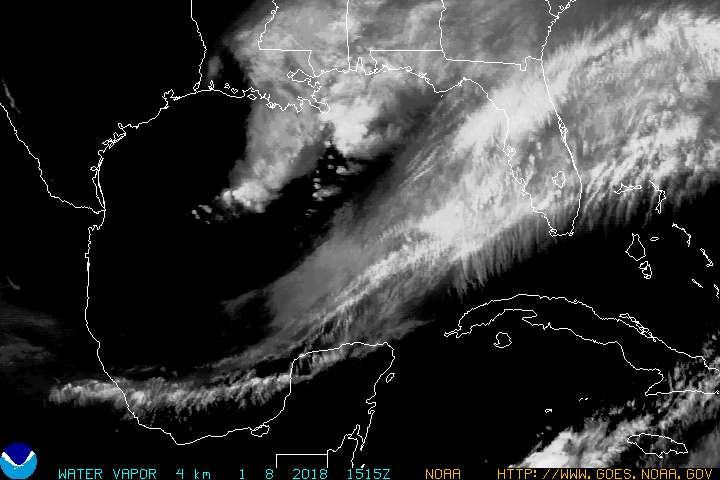
Latest Satellite Image of the Gulf of Mexico
A tropical storm approaching the Gulf of Mexico forced an evacuation Thursday of those working on oil cleanup operations and efforts to seal the well, federal and BP official said.
"While this is not a hurricane, this storm could have some significant impacts," said National Incident Commander Thad Allen.
Allen ordered the well site evacuated Thursday night "due to the risk that Tropical Storm Bonnie poses to the safety of the nearly 2,000 people responding to the BP oil spill at the well site." However, the cap that stopped the flow of oil into the Gulf a week ago will remain in place "even if the well is unattended," Allen said.
The storm was upgraded and named Tropical Storm Bonnie when Air Force reconnaissance aircraft detected winds of 40 mph, said hurricane specialist Richard Pasch of the National Hurricane Center in Miami. Bonnie is the second named storm of the season. Bonnie’s winds are forecast to increase to 50 mph by Sunday and could produce waves of up to 15 feet, Pasch said. Winds must reach 74 mph for it to become a hurricane.
The disruption of work at the well site began Tuesday, when ship crews monitoring the well, drilling two relief wells, and preparing to permanently plug the well, began preparing for evacuation, BP Senior Vice President Kent Wells said. The break in activities will last 10 to 12 days because the well site is being evacuated, Wells said.
He said BP will monitor the well as the storm approaches and resume monitoring as early as possible after it passes. The company is confident "that we can go away from the well site ... over that period," Wells said. Cleanup operations have been affected, said Coast Guard Rear Adm. Paul Zukunft, the federal on-scene coordinator for oil spill response.
Fifteen heavy offshore skimmers have pulled away from the well site and 1,300 fishing boats and private vessels involved in placing boom and skimming operations have been ordered to seek shelter, Zukunft said. "We’re pulling most of those resources inshore, and moving boom and other resources in the area to higher ground," he said.
Billy Nungesser, president of Plaquemines Parish, La., said he is disappointed operations are being scaled back. Nungesser said he’s keeping the parish’s skimming operation at sea until winds reach 50 mph. Boom that’s being trucked to higher ground would be just as safe inside his levees, Nungesser said. "I’m not evacuating people," he said.
Marc Jones, a former Navy officer who helped lead the Exxon Valdez cleanup in 1989, said a storm will churn any oil still in its path causing it to emulsify, or thicken. "It cuts the options that you have down. You cannot use dispersants, cannot burn it," he said. "
Contributing: Jessica Durando
Image courtesy BP via Reuters
Between Caps, Oil Gushes
Oil gushes from the uncapped BP wellhead on Saturday after the old "Top Hat" oil-containment cap was removed to make room for the tighter-fitting cap.
With no cap in place, more than 5 million gallons (19 million liters) of oil are estimated to have gushed out into the Gulf of Mexico during the two days before the new cap was installed.
BP and Coast Guard officials stress that the caps are just a temporary fix until the drilling of permanent relief wells is finished in mid-August. (Read more about the Gulf of Mexico relief wells in "Gulf Oil Leaks Could Gush for Years.")
Once the relief wells reach the broken well, they will be stuffed with heavy drilling mud and cement and should stop the flow of oil completely, according to BP.
Photograph courtesy BP via Reuters
New BP Cap Lowered Into Gulf
A portion of BP’s new containment cap is lowered into Gulf waters at the Deepwater Horizon wellhead site on Sunday.
The new cap was installed by Tuesday, but due to concerns from U.S.-government scientists, BP delayed a critical test of the containment cap’s integrity.
"As much as we want to do things as soon as possible, we also want to make sure they are done correctly," BP Senior Vice President Kent Wells said in a morning conference call Wednesday.
A major concern is that the new cap will allow too much pressure to build up in the oil well. If, during the integrity test, pressure in the well hovers around 9,000 pounds per square inch (psi), then it will indicate that the well’s structure is sound and the cap can be kept closed.
If the pressure drops to around 6,000 psi, however, it would mean that too much pressure has built up inside the well and that gas and oil is leaking into the surrounding sea floor through a new crack.
Feds say Gulf seepage not from BP cap
’Not unlike an oil leak you might have in your car,’ Allen says
WASHINGTON — The government’s oil spill chief tried to tamp down fears Tuesday that BP’s capped well is buckling under the pressure, saying that seepage detected along the sea floor less than two miles away is coming from an older well no longer in production.
Retired Coast Guard Adm. Thad Allen also said at least five leaks have been discovered around the well machinery, but he dismissed them as "very small drips" — "not unlike an oil leak you might have in your car."
Over the past few days, since a 75-ton cap was placed over the mile-deep well to keep the oil bottled up inside, BP and government engineers have been watching closely to see whether the well would hold tight or show signs of rupturing under the pressure. A rupture could cause a bigger and harder-to-control disaster. Allen has granted BP repeated 24-hour extensions to keep the cap in place, as long as the company monitors the well scrupulously.
Over the past few days, since a 75-ton cap was placed over the mile-deep well to keep the oil bottled up inside, BP and government engineers have been watching closely to see whether the well would hold tight or show signs of rupturing under the pressure. A rupture could cause a bigger and harder-to-control disaster. Allen has granted BP repeated 24-hour extensions to keep the cap in place, as long as the company monitors the well scrupulously.
Relief well on track
Meanwhile, the end game in the three-month crisis appeared to be drawing closer, with BP vice president Kent Wells saying the drilling of the relief well — necessary to permanently plug up the well — is on track. He said crews hope to drill sideways into the blown-out well and intercept it at the end of July.
At that point, they will begin the kill procedure — pumping mud and cement into the hole deep underground to seal it up once and for all. BP said that stage could take anywhere from five days to a couple of weeks.
"Everything’s looking good," Wells said. "The relief well is exactly where we want it. It’s pointed in the right direction, and so we’re feeling good about that." BP wants to leave the cap on in the meantime. At one point, Allen wanted instead to relieve the pressure by opening up the cap and siphoning oil up to ships on the surface, but he has relented in the past few days. Opening up the cap would have required allowing millions of gallons to gush into the sea again for a few days while the plumbing was hooked up.
In the meantime, engineers are considering shooting drilling mud down through the cap to increase the chances that the attempt to kill the well deep underground will succeed.
Seepage from older well
The seepage detected from the sea floor briefly raised fears that the well was in danger. But Allen said another well is to blame. The seepage is closer to the older well than to the one that blew out, Allen said. Also, he said, "it’s not unusual to have seepage around the old wells."
There are two wells within two miles of BP’s blowout off the Louisiana coast in the Gulf of Mexico. One has been abandoned and another is not in production. Around 27,000 abandoned wells in the Gulf aren’t checked for leaks, an Associated Press investigation showed this month.
The BP-leased Deepwater Horizon rig exploded April 20, killing 11 workers and touching off one of America’s worst environmental crises. The well has spewed somewhere between 94 million and 184 million gallons into the Gulf. BP said the cost of dealing with the spill has now reached nearly $4 billion.
The BP-leased Deepwater Horizon rig exploded April 20, killing 11 workers and touching off one of America’s worst environmental crises. The well has spewed somewhere between 94 million and 184 million gallons into the Gulf. BP said the cost of dealing with the spill has now reached nearly $4 billion.
Pressure readings
still not perfect for Gulf oil well
BP’s containment cap is staying in place for now, while the company and federal responders work toward a more-permanent solution for the Gulf oil spill.
BY MICHAEL VASQUEZ
Though oil has stopped flowing into Gulf waters, the containment cap BP is using to plug its deep-water well still isn’t registering the pressure readings scientists had hoped for -- prompting the federal government to emphasize Tuesday the importance of finishing a relief well in order to achieve a reliable, permanent closure.
BP, while working fast to complete such a well in the coming weeks, is also contemplating blasting mud, yet again, into the abyss. In the next day or two, BP hopes to receive federal approval for a ``static kill’’ procedure, which would not replace the existing cap but seek to further seal the oil well by pumping heavy mud into it.
The static kill is similar to a ``top kill’’ closure method that BP previously -- and unsuccessfully -- attempted. The difference now, according to BP Senior Vice President Kent Wells, is the top kill tried to stop oil that was gushing full blast into the Gulf. This time, with the cap already in place and the flow stopped, there will be no need to pump mud in at high rates and pressures. Ultimately, BP envisions the static kill working in tandem with the relief well -- speeding up the permanent closure process while also making that closure easier to execute.
The cap plugging the well has been in place for almost a week, but continues to be evaluated day to day. Federal responders and BP officials still don’t have an agreed-on explanation for why pressure readings from the now-closed oil well are less than what scientists expected: about 6,800 pounds per square inch instead of the desired 8,000 to 9,000 psi.
Lower pressure readings could mean leaks somewhere in the well casing, and worst-case scenarios for such a leak involve oil and gas flowing into the bedrock and mud, perhaps leading to a problematic collapse of the well. For now, though, even though the pressure readings aren’t quite perfect, retired Coast Guard Adm. Thad Allen said all the leaks that have been observed are minor and insignificant -- so the cap will stay put. ``We’ve been trying to come to grips with the pressure readings,’’ said Allen, the man in charge of the federal response to the spill. He spoke to reporters Tuesday afternoon, shortly after authorizing the cap to remain for another 24 hours. He stressed that a relief well -- two are still under construction and weeks away from completion -- is ``the ultimate way to solve the problem.’’
The containment cap could well stay in place until the relief well is finished -- even if its pressure readings are never perfect enough to instill full confidence. After the well is permanently closed, the massive cleanup of the nation’s worst-ever oil spill will continue -- with no clear end in sight. Since the BP-leased Deepwater Horizon rig exploded on April 20, killing 11 people, millions of gallons of crude have spilled into the Gulf, soiling the coastlines of all five Gulf Coast states.
About 87 miles of coastline in the Florida Panhandle has been ``oiled,’’ according to Gov. Charlie Crist’s office. While the Panhandle will continue to feel the effects of tar balls washing ashore in the coming days, state officials do not expect oil to hit other parts of Florida in the immediate future. The long-term outlook for where the mammoth slick will spread is difficult to forecast. One thing is certain: The economies of all states in the Gulf stand to suffer, especially tourism-dependent Florida.
A Moody’s economic report released this week estimated the BP spill could cost the Gulf Coast region about 17,000 jobs and about $1.2 billion in lost economic growth by year end. The report predicted Louisiana and Florida as the states likely to suffer most -- Louisiana because of its huge fishing and oil-extraction industries, Florida because the state relies on pristine beaches to attract visitors. Florida has long been the only Gulf state to resist opening its waters to offshore drilling -- yet the state got hit anyway.
Grover Robinson, a commissioner in Escambia County, home to Pensacola, said Florida should get any aid first because it had no role in the catastrophe. "I know we’re all in it together," he said. "But Florida’s injuries are greater because we don’t do this stuff."
Information from The Associated Press was included in this report.
Michael VasquezBP Gulf Oil Spill: Static Kill Within 48 Hours
It has been 3 months since the Deepwater Horizon went down off the coast of Louisiana, causing the worst oil spill in American history. BP has announced that its newest plans to stop the well, will include a procedure called "static kill". BP has admitted to the fact that the well is "breached", but they think that the lower pressure readings might give them the ability to carry out the static kill.
The static kill consists of pumping mud into the well, in hopes of forcing the oil deep down into the well. I don’t think this will work, and I’m sure they don’t either. For one, if the pressure is that low, then I’m sure we have some pretty bad "breaches" where oil is escaping. If they force a bunch of mud, then it will only push the oil towards these breaches, possibly making them worse. And if the breaches aren’t that bad, and the oil and mud have nowhere to escape, couldn’t the whole thing blow or create a pressurization issue? It really doesn’t make sense.
Another thing that doesn’t make sense: BP says the relief wells are almost done. If this is true, why risk anything? Why bother with the static kill? Well, apparently intersecting with the well bore isn’t an easy task, but the static kill is. Maybe BP is getting cold feet?
In the short term, BP is racing against the clock to do the static kill. They want to begin within 48 hours, and for good reason. Invest 97 is moving in closer to the Gulf, right now, and it may force another shut down of operations.
Pressure rises on BP, and the well
By TOM FOWLER
HOUSTON CHRONICLE
BP’s blown-out Macondo well remained sealed for a sixth day Tuesday, reducing the likelihood scientists will get another shot at measuring how fast oil was spilling from it while it tainted Gulf of Mexico waters and coastlines in the nation’s worst oil spill.
Retired Coast Guard Adm. Thad Allen, head of the federal spill response, gave BP at least through this afternoon to continue monitoring the well located in a mile of water off the Louisiana coast, which it capped last week after it spilled oil into the Gulf for nearly three months.
Retired Coast Guard Adm. Thad Allen, head of the federal spill response, gave BP at least through this afternoon to continue monitoring the well located in a mile of water off the Louisiana coast, which it capped last week after it spilled oil into the Gulf for nearly three months.
Small leaks of oil and natural gas have developed in five spots on the well, but federal and company officials say the leaks aren’t causing significant concern. A natural gas seep that was spotted 1.8 miles away from the well appears to be related to another well, either abandoned or not in production, Allen said.
Well pressure rising
Macondo well pressure continued to rise slowly, said BP Vice President Kent Wells, reaching 6,834 pounds per square inch. The longer the pressure continues to rise the less likely it is that the well casing below the sea floor has suffered a major failure and is leaking hydrocarbons in the surrounding strata. The well has been shut-in since Thursday afternoon, when engineers closed off the valves on a new cap installed on top of the well’s failed blowout preventer.
Originally the plan was to keep the well sealed for 48 hours to test the well integrity and then reopen it and allow an expanded oil collection system to capture the flow and bring it to ships on the surface. But that would require letting more oil spill, perhaps for as long as three days, while operators installed the collection system. Capturing the oil likely would give officials the most accurate measurements of the well flow, which BP and federal officials currently estimate was 35,000 to 60,000 barrels per day — almost 2.5 million gallons at the high end of that range.
The flow rate could help determine the final estimate of how much oil has spilled — and the amount of money BP will be fined for spilling it. $18 billion estimate Based on the 60,000-barrel rate, if BP were assessed the $4,300-per-barrel fine prescribed in federal law for negligent spills, the fines could be around $18 billion by some analyst estimates — allowing for the days the oil spilled and subtracting amounts successfully contained and sent to the surface before the well was closed last week.
Federal officials decided to prolong the well integrity tests, with increased monitoring for leaks, and to review the decision every 24 hours. While the pressure readings from the well give officials some idea of how much oil was flowing, the best way to measure the size of the leak would be to let it flow into a containment system and measure it directly, said Paul Bommer, a senior lecturer at the University of Texas petroleum engineering department and a member of the government’s Flow Rate Technical Group.
"This is what was taking place when BP had the well open," Bommer said. "The only problem was some of it was still leaking out around the bottom of the old cap." Allen said he has asked the technical group to look at the pressure data to see if it helps narrow their flow estimates, but Bommer said determining flow also involves such factors as fluid type, and the diameter, length and angle of pipes.
Allen acknowledged that the situation creates a dilemma, since getting an accurate flow rate would require letting more oil gush into the Gulf waters.
Concern over ‘static kill’
Greg McCormack, head of the Petroleum Extension Service at the University of Texas, said the most conservative move to ensure the well casing doesn’t blow out and create an even bigger problem would be to reopen the well, put up with three more days of spill and reattach the collection system.
"But having said, that I really want them to leave it shut," McCormack said. In a letter to BP and Allen on Tuesday, Rep. Edward Markey, D-Mass., expressed concern about the continued risks of shutting in the well and possible plans to seal it using a procedure called a static kill, a variation of the top kill that failed several weeks ago.
Both involve pumping drilling mud into the top of the well, but because oil isn’t flowing now, engineers say they could force the mud in under less pressure. Markey continued calls for a better measurement of the flow rate from the well and asked if the static kill "would kill off any chance at performing this test."
Allen and Wells said officials are looking closely at a static kill, but haven’t decided whether to try it. The static kill would not be a substitute for completion of a relief well to intercept the Macondo near its source two miles beneath the Gulf floor and plug it for good. The relief well has been drilled within feet of its target, and officials hope they can complete it by the end of the month.
tom.fowler@chron.com
China uses oil-eating bacteria to clean up spill
by Staff Writers
Beijing (AFP) July 20, 2010
Authorities in China are using over 23 tonnes of oil-eating bacteria to help clean up an oil spill in the Yellow Sea caused by a pipeline explosion and fire at the weekend, state media said Tuesday.
Yang Jiesen, head of the research and development division of a Beijing biotechnology company, said the Maritime Safety Administration had placed its order for the bacteria on Saturday, the official Xinhua news agency reported.
Dozens of oil-skimming vessels and hundreds of fishing boats were working to remove the slick off the northeastern port city of Dalian, after the accident on Friday that spilled an estimated 1,500 tonnes of crude into the sea.
"The use of the oil-eating bacteria at the Dalian spill is the first time China has made major use of biotechnology to solve an environmental pollution problem," the report said. T
he process, known as bioremediation, uses microorganisms to break down some toxic hydrocarbons present in crude oil into less harmful compounds. It was used to help mitigate the 1989 Exxon Valdez oil spill in Alaska. The Dalian incident has affected shipments of oil to southern China as the port has been partially closed, but refineries there are now processing inventories so oil prices are not expected to be impacted, Xinhua said.
Meanwhile, workers in Dalian are using oil barriers to prevent the slick from spreading, but are concerned wind and heavy rain could worsen the situation, it added. So far, at least 460 tonnes of oil have been scooped up, according to the report, which gave no more details about the size of the spill.
According to previous news reports, the worst of the spill initially covered 50 square kilometres (19 square miles) but had been reduced to 45 square kilometres as of Monday. But Xinhua reported then that a dark brown oil slick had stretched over at least 183 square kilometres of ocean.
’Static kill’ growing as option
to end Gulf oil spill drama
BP wants to try a ‘static kill’ in the Gulf oil spill – similar to the failed ‘top kill’ – to stopper the top of the well until relief wells kill it from below. A decision could come as soon as Wednesday.
Retired Coast Guard Adm. Thad Allen speaks to the news media about the BP Gulf oil spill in front of a line drawing of the containment stack at the site of the Deepwater Horizon oil spill in the Gulf of Mexico July 19, 2010. The stack is holding up so well that BP now wants to try a ‘static kill’ through it to close the well. – Alex Brandon/AP
No news is good news for BP as its jerry-rigged containment system is holding the renegade Macondo well at bay for a sixth day in a row, meaning that US authorities could soon give the go-ahead to a "static kill" that could finally end the now three-month-long Gulf oil spill drama.
The consideration of a "static kill" is a sign of growing confidence in the new cap. It suggests that officials do not think the new cap is causing new leaks that could make the surrounding seafloor unstable.
Retired Coast Guard Adm. Thad Allen, who is leading the federal relief effort, dismissed concerns about seepage near the well. The largest leak – two miles from the site – is now believed to be related to a different well. Other smaller leaks detected closer to the well are like "drips" that don’t yet indicate anything wrong with the well. Instead, pressure is continuing to build within the well – an "encouraging sign" that the well below is not severely damaged, Allen said. That has led BP to consider the so-called "static kill" procedure, which in some ways resembles the earlier, failed "top kill" effort. But BP senior vice president Kent Wells said Tuesday that the fact that the well is currently contained means it presents far fewer challenges than when it was blowing at near full-steam during the previous attempt.
"Unlike the ‘top kill,’ where we had to pump at high rates and pressure, that is not required with the ‘static kill,’ " Mr. Wells said. "We would start pumping at low rates and pressure and after we get some mud in the hold the pressure would start to go down. So you very quickly start seeing benefits as opposed to risk." Wells said the "static kill" would not replace the completing of relief wells but supplement it. While the relief well drill bits could breach the well casing as early as next week, it could take several weeks to permanently seal the well. "Static kill" could stopper the well securely in the meantime.
If "static kill" is approved by the unified incident command, which is led by Allen, BP would go ahead as quickly as possible. That decision could come as early as Wednesday. Government scientists want to be assured that built-up pressures from the containment cap won’t damage the well casing, potentially leading to another major setback – including the possibility of oil and gas leaking up uncontrolled from the seabed.
As of Tuesday afternoon, the pressure in the well was 6,834 pounds per square inch. Ideally, engineers had hoped for pressures to build to 9,000 psi, which would indicate that all the oil was staying within the column of the well bore and pressing up against the cap – not leaking into the surrounding bedrock. Scientists are unsure whether the lower reading suggests that some oil is leaking out of the well bore or if all the oil that has escaped into the Gulf has simply eased pressures within the reservoir.
story from the Christian Science Monitor
Oil cap kept shut
despite seepage near broken well
By COLLEEN LONG and HARRY R. WEBER(AP)
this image taken from video provided by BP PLC at 22:19 CDT, the containment stack is shown at the site of the Deepwater Horizon oil spill in the Gulf of Mexico Sunday, July 18, 2010. BP and the Obama administration offered significantly differing views Sunday on whether the capped Gulf of Mexico oil well will have to be reopened, a contradiction that may be an effort by the oil giant to avoid blame if crude starts spewing again.
NEW ORLEANS — The federal government Monday allowed BP to keep the cap shut tight on its ruptured Gulf of Mexico oil well for another day despite something seeping near the sea floor.
The Obama administration’s point man for the spill, retired Coast Guard Adm. Thad Allen, said early Monday that the company promised to watch closely for signs of new leaks around the mile-deep well, which has stopped gushing oil into the water since the experimental cap was closed Thursday.
Late Sunday, Allen said something was detected seeping near the broken oil well and demanded in a sharply worded letter that BP step up monitoring of the ocean floor. Allen didn’t say what was seeping. White House energy adviser Carol Browner told the CBS "Early Show" seepage was found less than two miles from the well site.
The concern all along — since pressure readings on the cap weren’t as high as expected — was a leak elsewhere in the well bore, meaning the cap may have to be reopened to prevent the environmental disaster from becoming even worse and harder to fix. An underground leak could let oil and gas escape uncontrolled through bedrock and mud.
"When seeps are detected, you are directed to marshal resources, quickly investigate, and report findings to the government in no more than four hours. I direct you to provide me a written procedure for opening the choke valve as quickly as possible without damaging the well should hydrocarbon seepage near the well head be confirmed," Allen said in a letter to BP Managing Director Bob Dudley.
When asked about the seepage and the monitoring, BP spokesman Mark Salt would only say that "we continue to work very closely with all government scientists on this."
Allen said BP could continue testing the cap, meaning keeping it shut, only if the company continues to meet their obligations to rigorously monitor for any signs that this test could worsen the overall situation.
Browner said Allen’s extension went until Monday afternoon.
"Clearly we want this to end. But we don’t want to enter into a situation where we have uncontrolled leaks all over the Gulf floor," Browner said Monday ABC’s "Good Morning America"
BP PLC said Monday that the cost of dealing with the oil spill has now reached nearly $4 billion. The company said it has made payments totaling $207 million to settle individual claims for damages from the spill along the southern coast of the United States. Almost 116,000 claims have been submitted and more than 67,500 payments have been made, totaling $207 million.
With the newly installed cap keeping oil from BP’s fractured well out of the Gulf during a trial run, this weekend offered a chance for the oil company and government to gloat over their shared success — the first real victory in fighting the spill. Instead, the two sides have spent the past two days disagreeing over what to with the undersea machinery holding back the gusher.
The apparent disagreement began to sprout Saturday when Allen said the cap would eventually be hooked up to a mile-long pipe to pump the crude to ships on the surface. But early the next day, BP chief operating officer Doug Suttles said the cap should stay clamped shut to keep in the oil until a permanent fix.
If the valves are kept closed, as BP wants, it’s possible that no more oil will leak into the Gulf of Mexico. Work on a permanent plug is moving steadily, with crews drilling into the side of the ruptured well from deep underground. By next week, they could start blasting in mud and cement to block off the well for good.
But the government is worried that the cap on the well is causing oil and gas to leak out elsewhere, which could make the sea floor unstable and cause the well to collapse. That’s why federal officials want to pump the crude to ships on the surface. That would require opening the well for a few days to relieve pressure before the pipes could be hooked up, letting millions more gallons of oil spill out in the interim.
It will take months, or possibly years for the Gulf to recover, though cleanup efforts continued and improvements in the water could be seen in the days since the oil stopped flowing. Somewhere between 94 million and 184 million gallons have spilled into the Gulf since the BP-leased Deepwater Horizon rig exploded April 20, killing 11 people and touching off one of America’s worst environment crises.
Weber reported from Houston. Associated Press writer Jay Reeves in Orange Beach, Ala., Tom Strong in Washington, AP video journalist Haven Daley in Biloxi, Miss., and Robert Barr in London contributed to this report.
Copyright © 2010 The Associated Press. All rights reserved.
Gulf oil spill cap to remain in place
-- for now
BY JAWEED KALEEM AND DANIEL CHANG dchang@MiamiHerald.com
No new oil from the broken Deepwater Horizon well head will flow into the Gulf of Mexico on Monday as scientists and engineers received another 24 hours to continue monitoring pressure readings on an experimental cap shutting in the well and to test for seepage of methane gas and oil detected in the sea bead.
Retired Coast Guard Adm. Thad Allen gave oil giant BP the extra time to continue integrity tests on the well following a Sunday night phone call between BP representatives and the federal science team assembled to study the spill.
While details of that conversation were not released, Allen issued a statement early Monday that said, in part, ``The federal science team got the answers they were seeking."
A section of new containment cap stack is pictured during ‘well integrity testing’ in this image captured from a BP live video on July 15, 2010. Credit: Reuters/BP/Handout
Allen’s statement followed a sharply worded letter he wrote to BP and released late Sunday, noting that extensive monitoring of the sea bed surrounding the spill site -- including seismic surveys and acoustic testing -- had detected a seep ``a distance from the well and undetermined anomalies at the well head."
No details were given on the size or exact location of the seep, or on what it was made of, but a seep is usually a flow of hydrocarbons, which occur naturally in crude oil. The seep could mean that oil is leaking from the sea bed once again. White House energy advisor Carol Browner told the CBS "Early Show" the seepage was found less than two miles from the well site.
Government officials are worried that the cap on the well may force oil and gas to leak uncontrollably into the bedrock and mud, making the sea floor unstable and risking a collapse of the well. In the letter to BP, which owns the broken well, Allen urged the company to quickly tell the government of any seeps and requested a plan for quickly opening the well’s choke valve to allow oil to flow -- and likely be siphoned up to boats -- if there’s a leak.
The new containment cap is seen during the "well integrity testing" in the image grabbed from the BP’s live video feed in the Gulf of Mexico, July 15, 2010. British oil giant BP said Thursday the new cap on well is fully closed and no oil is going into Gulf during the well integrity test conducted by the company. (Xinhua/BP LIVE FEED)
If the well leak is confirmed, the cap will likely be reopened to prevent the environmental disaster from becoming even worse and harder to fix. That means oil would likely gush once again into the ocean after three days of no new oil. BP reported Monday that the broken well, located one mile below the surface of the Gulf, was still shut in with a containment cap lowered over the well head last week. The company has been testing the well’s pressure, and reported that it continued to slowly increase -- an encouraging sign -- to a reading of about 6,800 pounds per square inch on Monday morning.
Ideally, engineers are looking for pressure readings between 8,000 and 9,000 pounds per square inch, which would indicate minimal or no damage to the well bore. Early Sunday, BP and federal officials gave differing accounts about the success of the containment cap placed on the oil well July 15.
BP Chief Operating Officer Doug Suttles had indicated that the company wanted to leave it in place until permanent relief wells were finished in August, well beyond an initial two-to-three day test period BP and the Obama administration had announced. As long as the cap held, "there is no target set to open the well back up to flow," Suttles had told reporters Sunday. ``No one associated with this whole activity . . . wants to see any more oil flow into the Gulf of Mexico,’’ he said. But Allen, the U.S. government’s point man on the oil spill -- and the person with the final say -- outlined a different plan just hours later, saying ``nothing has changed" and that more testing was needed on the containment cap. "The ongoing well integrity test will continue with the potential for additional extensions in 24-hour increment," he said.
Sunday’s letter said the testing would continue but reflected increased government concern about safety issues. It also showed that BP’s hopes to keep the containment cap on -- and the well sealed -- were less likely to go forward, despite the effort being the company’s only success at a complete, if potentially temporary, plug to keep oil from gushing into the ocean. Earlier Sunday, Allen said more work was needed to better understand why pressure readings from the well cap are lower than expected. There could be two reasons, he said: Either there’s less oil in the reservoir because so much has flowed out, or oil is leaking out underground.
A pressure reading of over 7,500 psi, or pounds per square inch, would indicate the well casing is intact. A lower reading could suggest a leak. "While we are pleased that no oil is currently being released into the Gulf of Mexico and want to take all appropriate action to keep it that way, it is important that all decisions are driven by the science," Allen said. Allen previously said that once tests were complete, the cap would be hooked up through nearly a mile of pipes stretching to ships on the surface that will collect the oil. That would mean oil would have to be released back into the Gulf for possibly three days to release pressure from the well.
The Associated Press contributed to this report.
BP shares plunge after engineers detect seepage at capped Deepwater Horizon well
By Daily Mail Reporter
The US government has ordered BP to provide a plan for reopening its capped well in the Gulf of Mexico after engineers found seepage and possible methane gas near the leak site.
The energy giant had wanted to test its cap until it could open relief wells to stop the flow of oil, but the discovery of seepage and possible methane gas near the site in the Gulf of Mexico means there could still be leaks.
But the discovery of seepage could mean there are still leaks in the damaged well.
BP shares fell by as much as 5 per cent today as investors reacted to the latest developments in the disaster, which began when the Deepwater Horizon rig exploded on April 20, killing 11 workers. Shares dipped below 300p at one stage last month - the lowest point since August 1996 - but last week recovered to around 425p on signs that it is closer to tackling the crisis, which BP said today has now cost $US4bn (£2.6bn) in spillage and clean-up.


BP shares fell by as much as 5 per cent today as investors reacted to the latest developments in the disaster, which began when the Deepwater Horizon rig exploded on April 20, killing 11 workers. Shares dipped below 300p at one stage last month - the lowest point since August 1996 - but last week recovered to around 425p on signs that it is closer to tackling the crisis, which BP said today has now cost $US4bn (£2.6bn) in spillage and clean-up.
Seepage: BP have been ordered to provide a plan for reopening its capped well in the Gulf of Mexico after engineers found seepage and possible methane gas near the leak site
The US government’s plan is to pipe oil to the surface, which would ease pressure on the well but would require up to three more days of oil spilling into the Gulf.
Doug Suttles, BP’s chief operating officer, said last night: ‘No one associated with this whole activity ... wants to see any more oil flow into the Gulf of Mexico.
"Right now we don’t have a target to return the well to flow."
Retired Coast Guard Admiral Thad Allen, who is in charge of the White House’s reponse to the spill, ordered BP to provide a plan for reopening the well by 1am today (UK time). In a letter to BP managing director Bob Dudley, he said: ‘When seeps are detected, you are directed to marshal resources, quickly investigate, and report findings to the government in no more than four hours.
Retired Coast Guard Admiral Thad Allen, who is in charge of the White House’s reponse to the spill, ordered BP to provide a plan for reopening the well by 1am today (UK time). In a letter to BP managing director Bob Dudley, he said: ‘When seeps are detected, you are directed to marshal resources, quickly investigate, and report findings to the government in no more than four hours.
All hands on deck: Boats continue to monitor the situiation at the source of the BP Deepwater Horizon oil spill
Damage: After 90 days oil sheen can be seen for miles along the surface of the Atlantic near the spill
‘I direct you to provide me a written procedure for opening the choke valve as quickly as possible without damaging the well should hydrocarbon seepage near the well head be confirmed.’
The blow comes as the oil giant was reported to be considering selling off its petrol stations.
Directors at the beleaguered oil group are understood to have held discussions with its major shareholders over restructuring the company following the crisis, according to the Sunday Times newspaper.
Options under consideration are thought to include splitting up the group by selling off its refineries and petrol stations, scaling back its US operations and doing more engineering in-house rather than outsourcing it.
Options under consideration are thought to include splitting up the group by selling off its refineries and petrol stations, scaling back its US operations and doing more engineering in-house rather than outsourcing it.
Resolution: The U.S. Government has told BP tthat failure to deal with the problen is unacceptable
The restructuring will come on top of the sale of around 10% of the group’s assets, which will be needed to meet the cost of the oil spill, which so far reached 3.5 billion US dollars (£2.29 billion).
Discussions with shareholders are said to be at an early stage, but they will be used to help decide the direction of a formal strategic review, which is expected to be launched by the group’s chairman Carl-Henric Svanberg once the ruptured well is finally sealed.
News that the leak was stopped on Thursday helped BP shares soar around 8% higher at one stage on Friday, although wider stock market falls later pared the gains back.
It is thought the restructuring of BP could leave it a significantly smaller firm, which would focus on exploration in emerging oil regions, such as West Africa and Brazil, and lead to it selling off its less profitable downstream arm. The downstream business, which is made up of petrol stations and refineries, employs around 51,600 people - more than half of BP’s 80,300 workforce - but accounts for just 3% of the company’s pre-tax profit.
It is thought the restructuring of BP could leave it a significantly smaller firm, which would focus on exploration in emerging oil regions, such as West Africa and Brazil, and lead to it selling off its less profitable downstream arm. The downstream business, which is made up of petrol stations and refineries, employs around 51,600 people - more than half of BP’s 80,300 workforce - but accounts for just 3% of the company’s pre-tax profit.
Disaster: The explosion at Deepwater has forced BP into a major restructuring of their finances and the way they drill
Meanwhile, discussions are thought to be continuing between BP and US oil firm Apache Corporation over the sale of 12 billion US dollars (£7.84 billion) worth of assets, including its stake in Alaska’s Prudhoe Bay.
BP’s board is understood to be due to meet later this week to discuss what assets will be sold off to pay for the oil spill, according to the Mail on Sunday.
As well as Prudhoe Bay, the group is also thought to be considering offloading its assets in Argentina, where it has a 60% stake in oil company Pan American Energy worth around £3.5 billion, as well as oil and gas fields in Vietnam, Colombia and Venezuela, worth around £1 billion.
A BP spokesman declined to comment on the speculation. BP said last month that it was making a £13 billion fund available to compensate people affected by the Gulf of Mexico oil spill. Its shares dipped below 300p at one stage last month - its lowest point since August 1996 - but recovered to more than 400p amid signs that it was closer to tackling the crisis.
The disaster began when the Deepwater Horizon rig exploded on April 20, killing 11 workers. Relief wells being drilled miles beneath the seabed will be the only means of permanently sealing and isolating the damaged well. The first of the wells is expected to be finished by the end of the month. It is thought more than four million barrels of oil have so far flowed into the Gulf.